The rise of 5G Technology
Fifth Generation (5G) Technology is a recent generation of mobile networks. It stands out as a revolutionary force, promising unprecedented speed, connectivity, and innovation in this rapidly evolving world of telecommunications.
In this article, we will explore the depths of 5G, its technology, applications, and its key distinctions from its predecessors.
So what is 5G?
Fifth-generation wireless (5G) is the latest iteration of cellular technology. 5G was engineered to greatly increase the speed and bandwidth of wireless networks whilst reducing latency when compared to previous wireless standards. It also gives the ability to connect an extensive array of devices simultaneously.
In order to enable faster speeds, lower latency, and diverse application support, 5G technology infrastructure includes different key components such as
- RAN (Radio Access Network): which connects user devices to the core network, utilizing technologies like Massive MIMO and beamforming.
- Core Network: It is central to 5G architecture, manages data traffic and services, incorporating Mobile Edge Computing for lower latency.
- Millimeter Waves: They are higher frequency bands, ranging from 24 GHz to 100 GHz that enable faster data transfer rates.
- Small Cells: They increase network capacity with strategically placed low-powered cellular nodes in urban areas.
- Network Slicing: It allows the creation of multiple virtual networks, customizing parameters for different applications or industries.
- Beamforming: It focuses radio wave transmission towards specific devices, improving signal strength and reducing interference.
- Massive IoT Connectivity: It optimizes the network to support a vast number of connected devices with varying data transmission requirements.
What are the diverse applications of 5G?
-
Enhanced Mobile Broadband (eMBB):
It firmly stands as the quintessential application of 5G, reflecting the evolution of contemporary mobile broadband. eMBB not only allows for the processing of larger data quantities but also significantly enhances the user experience. With speed surpassing traditional cable connections, users can seamlessly engage in activities like streaming, online gaming, and immersive augmented reality experiences on their mobile devices. Furthermore, 5G’s ability to handle higher end-user data rates is shown by many applications, including UHD video (4K, 8K), 3D video, tactile internet, cloud gaming, broadband kiosks, remote classrooms, holograms, virtual reality (VR), augmented reality (AR), and real-time simulation and training…etc.
-
Massive Machine-Type Communications (mMTC):
5G’s expansive connectivity is a game-changer for the IoT, particularly in mMTC. This involves services with a large device population, including remote sensors, equipment monitoring devices, and actuators. Key requirements for mMTC services are low device cost and efficient device energy usage, ensuring a longer battery life that can span several years. Each device in mMTC merely receives and generates a limited amount of data, making support for high data rates less critical in this context. The technology facilitates flawless interconnection among devices, creating an ecosystem where machines communicate effortlessly.
-
Ultra-Reliable Low Latency Communications (URLLC):
5G’s Ultra-Reliable Low Latency Communications services are tailored for applications demanding extremely low latency and exceptional reliability. Examples include traffic safety, factory automation, automatic control, self-driving vehicles, e‑health in hazardous environments, rescue missions, vehicular communication, and drones. These services benefit significantly from 5G’s ultra-reliable low latency, ensuring minimal delays and supporting critical scenarios where split-second decisions are paramount, such as in remote surgery and autonomous vehicles.
5G vs. Previous Generation
4G vs. 5G: In comparison to 4G, 5G boasts significantly faster speed and reduced latency. This leap enables smoother and more responsive user experiences, paving the way for innovations in extended reality applications, virtual reality, and more.
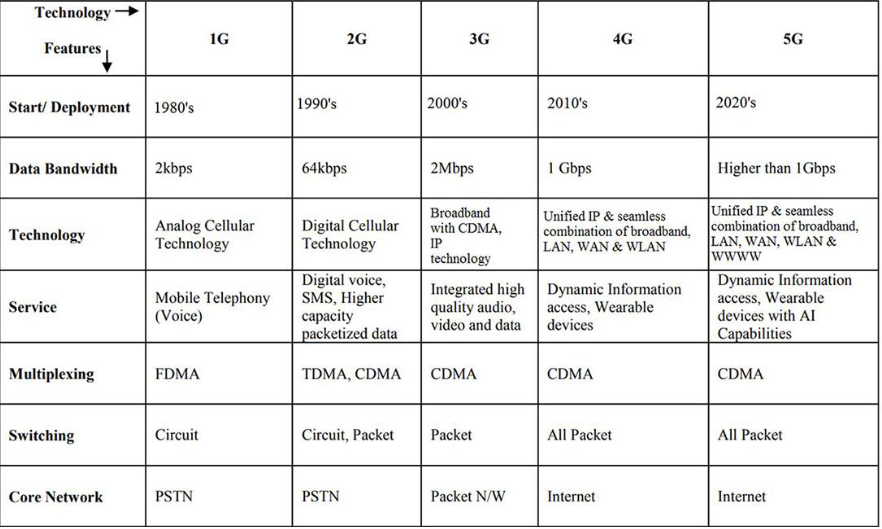
3G and 2G Comparison: While 3G and 2G laid the groundwork for mobile communication, 5G represents a quantum jump in data transfer speeds, communication efficiency, and network capacity. The evolution from 2G’s voice-centric services to the data-centric capabilities of 5G is nothing short of revolutionary.
Source: https://my.element14.com/
1G: The Birth of Mobile Communication
- Originating in the 1940s with car phone services, 1G networks emerged in the 1980s.
- Used analog technology (e.g., AMPS in the U.S., NMT in Europe).
- Primarily designed for voice calls with limited capacity and security.
2G: The Advent of Digital Communication
- 1990s saw the rise of 2G networks, adopting digital transmission.
- Digital signals improved efficiency, allowing more concurrent calls.
- Introduction of SMS and diverse technologies worldwide (e.g., GSM, D‑AMPS, cdmaOne).
3G: The Era of Internet Mobile
- 3G networks in the early 2000s brought faster data speed.
- Enabled web browsing, emails, and basic multimedia on mobiles.
- Video calling, smartphones, and app stores emerged during this era.
4G: The Rise of Mobile Broadband
- Around 2010, 4G networks provided significantly increased data speed.
- Reduced latency facilitated real-time video streaming and online gaming.
- Led to an explosion of mobile apps and services, fostering the growth of IoT.
5G: More Than Just Faster Internet
- 5G was introduced as the next step in mobile communication evolution.
- Designed for higher data transfer rates, lower latency, and improved reliability.
- Supports a larger number of devices and data-intensive applications (e.g., VR, AR).
- Key features include massive IoT connectivity, mission-critical applications, enhanced mobile experiences, and energy efficiency.
Global 5G adoption and the Future of 5G Technology
In terms of global connectivity, 5G has evolved from a visionary concept to a reality that continues to reshape the mobile industry and impact users worldwide. 5G stands out for its flexible and fluid capabilities, set to make waves across the globe. According to the GSMA, the projection is bold – 5G networks are expected to cover one-third of the world’s population by 2025, propelled by the increasing integration of the Internet of Things (IoT) in commercial and industrial domains.
Global 5G Adoption:
The anticipated shift to 5G promises to be ten times faster than 4G LTE networks. This transition could potentially become the most significant growth driver for the smartphone industry in the upcoming years. Greater China emerged as the torchbearer in 2021, boasting a 29% adoption rate and pioneering over 10,000 5G applications in education, healthcare, and transportation. While North America and Europe are currently trailing with 13% and 4% adoption, the prediction foresees North America surpassing China by 2025 with an impressive 63% adoption, while the rest of the world maintains their reliance on 4G so far.
Early Adopters:
Several countries stand out as early adopters, showcasing innovative applications of 5G:
- Singapore leverages AI for an eco-smart city with smart energy management.
- Austria’s WienBot employs constant learning to understand public queries.
- San Diego, California, utilizes an app to connect and manage citizen service requests.
- Japan employs sensor data to monitor water usage, amassing over 45 million 5G subscriptions by March 2022.
- Saudi Arabia, notably with Saudi Telecom, leads in 5G coverage and anticipates supporting 45 million new 5G-supported IoT devices by 2030. Other closely adapting nations include Spain, Italy, Australia, Canada, the UK, South Korea, and Finland
Five Intriguing 5G Applications (2023):
- Smart Cars: Connected cars are set to dominate the global 5G IoT endpoint market, reaching a 39% market share by 2023. Applications include automotive safety, position sharing, and autonomous driving.
- Video Surveillance: Security systems are exploring new possibilities with 5G’s speed and low latency, with Gartner predicting a substantial increase in 5G IoT endpoint installations by 2023.
- Healthcare Advancements: Telehealth services benefit from 5G, offering improved communication, reduced delays, and enhanced access to critical healthcare services.
- Smart City Revolution: 5G provides the foundation for smart cities to connect, utilizing sensors, analytics data, and more. The global IoT in smart cities is expected to grow by 18.8%.
- Smart Grid Automation: 5G enables smart grids with features like low-cost maintenance, network slicing, and automation, driving utility operators towards millisecond-level precise load control and distributed automation.
The Future of 5G Network (2025–2030)
Despite a relatively slow adoption rate, the future of 5G appears promising. Expected to increase connectivity, improve communication, enhance virtual and extended reality experiences, and drive business productivity, 5G’s growth is fueled by its low latency advantage. As countries globally invest in making 5G mainstream, we anticipate a global shift towards embracing this transformative technology, ushering for a new era of connected innovation.
Forecast share of 5G mobile connections in selected countries worldwide in 2030

Source : https://www.statista.com/
Closing thoughts
As 5G has become more widespread globally, we’re entering a new era of endless connectivity. It’s not just about faster downloads – 5G is paving the way for countless technological breakthroughs. In the next few years, we can expect 5G to bring people and devices together in ways we never thought possible.